 splines
← all scripts / norns
terrarium new
A small world of Mutable Instruments for monome norns
install
In maiden's REPL (the >> prompt at the bottom of the editor), run:
;install https://github.com/carlosedp/terrariumOr add the splines catalog to maiden and install it from the project manager. Restart norns if the script ships a new engine.
readme from carlosedp/terrarium
 terrarium
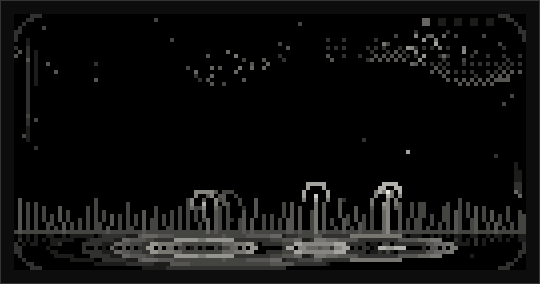
A small world of Mutable Instruments for monome norns.
Read the manual for how to play it (also as a PDF), or try it in your browser, phones included: the real script, playing the real Mutable Instruments code.
The patch is a landscape. Five parts each draw one piece of the scene and play one part of the sound. Swap a module and that piece of the scene changes; turn a macro and the scene moves with the sound. The screen shows no numbers.
| Part | In the scene | Modules |
|---|---|---|
| weather | when notes happen and which ones | rain (clocked to the norns clock), lightning (random), snow (drifting, and it settles) |
| soil | what grows from the ground: what plays | meadow (Plaits), crystals (Plaits 6-op FM), reeds (Rings), visitors (any nb voice) |
| water | the pond and the fog: what shapes it | pond (Rings), fog (Ripples) |
| air | the sky: where it rings out | clouds (Clouds), fireflies (Beads), mountains (MiVerb) |
| hum | always there, under it all, on the key's root and fifth | aurora (Plaits), roots (Elements), none |
The whole scene sits behind the terrarium's glass. Rain beads up on it, and freezing the air frosts it over.
Every note is a place: where it lands across the screen sets its pitch in the current key and scale. The weather keeps a Turing Machine-style phrase, and each note leaves a mark on the ground. Change sets how often notes are replaced, dropped to a rest or added back. Seasons (slow by default) let the key drift between close neighbors and find its way home.
Status: v0.1, untested on hardware. The Lua side runs headless against a mocked norns (see Development); the engine and the sound mappings still need a real norns.
Requirements
- norns (or norns shield / fates)
- mi-UGens built for norns. If they're missing,
terrarium shows an installer instead of the scene: K3 downloads and installs the latest
build, K2 installs a
mi-UGens-norns*.tar.gzyou copied intodust/. Restart norns after. Fireflies needs a build that includes MiBeads; without it, that module is hidden.
Install
From the maiden REPL:
;install https://github.com/carlosedp/terrarium
nb comes in as a git submodule (lib/nb). Cloning by hand,
use git clone --recurse-submodules.
Controls
| Control | Does |
|---|---|
| E1 | choose a part (the others dim for a moment) |
| E2, E3 | that part's two macros (their names show for a moment while you turn) |
| K2 | swap the part's module |
| hold K2 + E2 | pick the module's variant: Plaits engine (meadow), DX bank (crystals), Rings model (reeds, pond), nb voice (visitors), Clouds mode |
| K3 | gesture: new phrase (weather), strike (soil, water), freeze (air), hush / rise (hum) |
| hold K1 | peek at all parts; while held, E2 picks a setting and E3 changes it |
| hold K1 + K3 | a new terrarium: random modules, varieties, knobs and settings, all but the day (also PARAMS > randomize the jar) |
Climate (a setting, off by default) lets a chaotic attractor slowly move the macros: fronts (Lorenz), gusts (Rössler), tides (Thomas) or squalls (Chua). It moves them, the way CV moves a module's knobs: the macro you set is the center and the climate pushes it around it. Each macro has a cv amount in PARAMS; the peek view shows where each macro is right now and the attractor's path.
Day (a setting, off by default) adds the longest arc: a day and night of 20 minutes, an hour, or following the norns' clock. Night slows the weather, darkens the soil, opens up the air and brings the hum forward; the sky shows a sun by day and a moon and stars by night.
Erosion (a setting: off, faint, worn, deep, ancient; faint by default) gives the whole sound the wear of an old recording: wow, flutter, crackle, hiss, a rolled-off top, a little warmth. It glues the notes, the hum and the sky together; dust settles on the glass as it wears.
Snow (a weather module) falls slower and looser than rain and settles on the ground. The snow cover muffles the soil, more the longer it snows; with the day on, the sun thaws it (the meltwater drips a few soft notes) and the night lets it build up again.
Breath (a setting, gentle by default) adds silence: now and then the weather calms for a phrase or three, notes rest (the phrase keeps them) and their marks dim, then it breathes in again.
Presets: norns saves them for you: in the norns menu, PARAMS > PSET > save / load. A preset holds everything, including modules, variants, settings, levels, and whether the air is frozen or the hum hushed.
A quick tap of K1 still opens the norns menu. Settings (key, scale, range, length, seasons, climate, drift, day, breath, erosion), every macro, and each module's fixed options (Plaits engine, DX bank, Rings model, Clouds mode) are also in PARAMS, so they save with PSETs and can be MIDI-mapped.
How it's built
terrarium.lua            script: parts, params, controls, drawing, the brain clock
lib/Engine_Terrarium.sc  engine: 2 Plaits voices -> color slot -> air slot -> out
lib/brain.lua            phrase, pitch mapping, seasons
lib/canvas.lua           128x64 framebuffer, blitted to the screen as merged runs
lib/glass.lua            the glass over the scene: rim, condensation, frost
lib/climate.lua          chaotic attractors that modulate the macros
lib/nb/                  the nb library (git submodule), for visitors
lib/scene/*.lua          one file per module: its drawing, macros and sound mapping
lib/installer.lua        mi-UGens check and installer
doc/SOUND.md             macro -> mi-UGen parameter map (the tuning reference)
lib/Engine_Terrarium.js  the engine for norns-web: the same graphs, in Web Audio (norns ignores it)
lib/Engine_Terrarium/    the mi-UGens it plays, built as WebAssembly (`make mi-wasm`)
tools/norns-web/         runs the script's real Lua in a browser
test/                    mocked norns runtime and a smoke test
The Lua side owns every macro-to-parameter mapping (each module's sound() function, written
from doc/SOUND.md); the engine only exposes raw parameters per slot. Tuning the
sound means editing those functions.
On screen the parts are weather, soil, water, air and hum; in the code (param ids, tune(),
module files) they keep their working names: brain, voice, color, air and drone.
A module is one file under lib/scene/ with macros, draw, update, and either
wait/spawn/wind (brain; flash optional) or sound/on_note (voice, color, air). Add it to LAYERS in terrarium.lua; a new
color or air module also needs a terrarium_<id> SynthDef in the engine.
Development
make lists the common tasks: make web (the script in a browser), make test, make deploy
(copy to a norns over ssh; NORNS=we@<ip> if norns.local doesn't resolve).
Run the smoke test on a computer (Lua 5.3+):
lua test/smoke.lua
It loads the script against test/mock_norns.lua, plays every module, gesture and setting,
exercises the installer path, and prints screen calls per frame. It checks the Lua logic only:
no sound, no real screen.
lua test/soak.lua [hours] (make soak) runs the jar for hours of jar time (8 by default, about
1.5 minutes each) with climate, a day, seasons and breath on and a new terrarium every 20
minutes, and fails on what only shows up over hours: growing memory or lists, values out of range
or NaN, silence, a hum stuck hushed.
To see and play the real script in a browser, run norns-web:
node tools/norns-web/serve.mjs # then open http://localhost:8800/
It runs this Lua as is (screen, controls, clocks, PARAMS). The engine is lib/Engine_Terrarium.js:
each SynthDef rebuilt in Web Audio around the same mi-UGens, compiled to WebAssembly by
norns-mi-UGens (./build.sh --wasm) and kept in
lib/Engine_Terrarium/ (make mi-wasm rebuilds them). Every push to main publishes it to
https://carlosedp.github.io/terrarium/ (.github/workflows/pages.yml).
Tuning
Each module's macro → parameter mapping is a table that tune() changes live from the maiden
REPL, printing the result to paste back; PARAMS > levels balances the slots. See
doc/SOUND.md for the syntax and a first-night checklist.
To do on hardware
- engine loads and every slot sounds; fix anything SuperCollider complains about
- CPU with the heaviest combination (2 Plaits + Rings + Beads); pick voice count from it
- screen frame time (the smoke test averages about 730 screen calls per frame and peaks around 1,550 with fog or a lightning flash; the pond's reflection is the main extra cost)
- tune ranges and curves in each module's
sound()by ear (doc/SOUND.md lists open questions) - visitors with real nb voices (Emplaitress, MIDI, Just Friends); they play dry, outside color and air
- grid: phrase editing, key/scale picker
License and copyright
terrarium is made by Voltage Foundry Modular. © 2026 Voltage Foundry Modular.
- The code is free software under the GNU GPL v3.0 (see LICENSE): you can use, study, share and change it under its terms.
- The terrarium name, the manual and its images are © 2026 Voltage Foundry Modular, all rights reserved.
- Built on others' work: the sound is Émilie Gillet's
Mutable Instruments code, via Volker Böhm's
mi-UGens (GPL-3.0), installed separately on the norns. The
browser version carries WebAssembly builds of seven of them in
lib/Engine_Terrarium/, built from norns-mi-UGens (BUILDINFOthere records the source). nb by sixolet is a git submodule; wasmoon (MIT) is vendored intools/norns-web. - Mutable Instruments, monome, norns and all other product names are trademarks of their respective owners, used only to identify what terrarium works with. No affiliation with or endorsement by them is implied.
discussion
Like this script? React with 👍 or ❤️ below (needs a GitHub account). Reactions count as likes (♥) on splines, updated daily.